
December 16, 2025
Article
Introduction: The Invisible Bottleneck in Workshop Operations
For most garages and service workshops, spare parts sourcing is not seen as a strategic problem. It’s treated as a daily operational task—something that just needs to get done so the real work can begin.
But in reality, spare parts sourcing is one of the biggest hidden bottlenecks in workshop operations.
Delays in identifying the right part, uncertainty around availability, and time spent coordinating with multiple suppliers all compound into lost productivity, longer vehicle downtime, and frustrated customers. Over time, these inefficiencies quietly erode margins and limit growth.
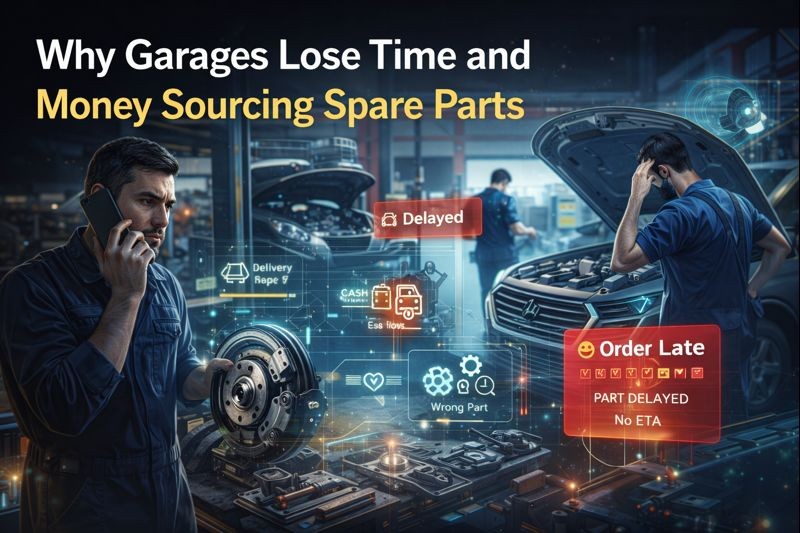
The Typical Spare Parts Sourcing Workflow Today
In many garages, especially across the Middle East and emerging markets, the workflow looks like this:
A vehicle arrives with an issue
The mechanic identifies the faulty component
Someone takes a photo or notes a part number
Calls are made to multiple suppliers
Prices and availability trickle in slowly
Decisions are made with incomplete information
This process is repeated dozens of times a day in busy workshops.
What makes it worse is that most of this effort is invisible. It’s not tracked, measured, or optimized—yet it directly impacts service timelines and customer satisfaction.
Time Lost Before the Repair Even Begins
One of the biggest costs garages face is idle time.
A vehicle waiting for parts:
Occupies valuable workshop space
Blocks technicians from moving to the next job
Delays billing and revenue recognition
Even a one-hour delay per job adds up quickly when multiplied across multiple vehicles and days.
In practice, garages often wait far longer:
Waiting for suppliers to respond
Waiting for confirmation on compatibility
Waiting for alternative options when originals aren’t available
Each delay pushes delivery timelines further out.
The Risk of Wrong or Incompatible Parts
Another major source of loss is incorrect part orders.
This happens when:
Parts look similar across models
Part numbers are incomplete or outdated
Compatibility isn’t clearly validated
Decisions are rushed under pressure
Wrong parts lead to:
Reordering costs
Additional downtime
Customer dissatisfaction
Loss of trust
For garages, one wrong part can turn a profitable job into a loss.
Over-Reliance on Calls and Informal Networks
Many garages depend heavily on:
A small set of trusted suppliers
Phone calls and WhatsApp messages
Personal relationships rather than structured data
While this works at small scale, it breaks down as volume increases.
Problems include:
No price transparency
Supplier dependency
No comparison across options
No visibility into better alternatives
Garages often don’t know whether they’re getting the best price, the fastest delivery, or the most reliable option.
The Hidden Cost of Unpredictability
Uncertainty is expensive.
When garages can’t predict:
When parts will arrive
Whether the part will fit
Whether a better option exists
They compensate by:
Over-ordering
Holding excess inventory
Accepting suboptimal pricing
These decisions are defensive, not strategic—but they increase costs over time.
How AI Changes Spare Parts Sourcing for Garages
AI-powered platforms fundamentally change how garages interact with the aftermarket.
Instead of calling and waiting, garages can:
Search parts using images, text, or voice notes
Instantly match parts to vehicle models
Compare multiple suppliers in real time
See price, stock, and delivery timelines clearly
Choose based on urgency or cost
This transforms sourcing from a guessing game into a decision-making process.
From Reactive to Proactive Sourcing
With intelligent sourcing tools, garages move from reactive to proactive operations.
They can:
Anticipate delays
Choose faster alternatives
Avoid repeat mistakes
Reduce downtime consistently
Over time, this leads to:
Faster turnaround
Higher throughput
Better customer experiences
Why This Matters More Than Ever
As vehicles become more complex and customer expectations rise, garages can no longer afford inefficient sourcing workflows.
Speed, accuracy, and confidence are no longer optional—they are competitive advantages.
How PartLogiq Fits into the Workshop Workflow
PartLogiq is designed around how garages actually work.
It enables:
Photo-based searches from the workshop floor
Voice-based searches in local languages like Arabic
Access to OEM and approved aftermarket alternatives
Supplier comparison without making calls
Reduced risk of counterfeit or incompatible parts
By digitizing sourcing, PartLogiq helps garages reclaim time and margin.
Closing
Garages don’t lose money because they lack skill.
They lose money because sourcing is slow, manual, and uncertain.
The workshops that thrive will be those that treat spare parts sourcing as a core operational capability, not an afterthought.